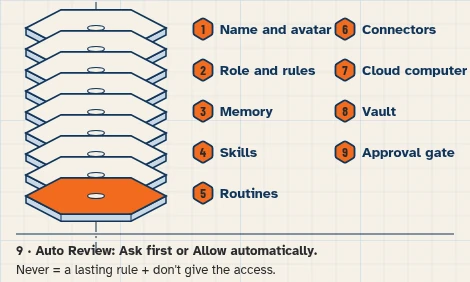
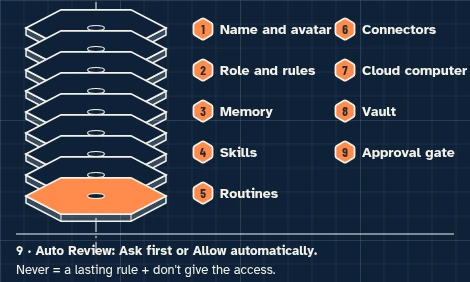
This walkthrough uses a fictional business and test accounts only. It sets up no live messages or routines.
This walkthrough prepares one morning brief from a loads sheet and two test emails you enter. It does not send mail or SMS, file a document, or connect a dispatch system, load board, ELD or GPS tool. It does not give compliance advice.
At a glance
What you’ll have at the end
A fictional Switchyard Dispatch Assistant Bot, set up on a test account, that can:
- Read the loads, paperwork flags and target rate already on a sheet you fill in.
- Propose a proof-of-delivery file name in this chat, without moving or saving a file.
- List unbilled loads still missing paperwork, flag loads at or above the target rate on the sheet, and draft an unsent driver note.
Staff still review every draft and decide what is sent or filed. This walkthrough has not been run end to end. A morning routine is optional later; this walkthrough creates none.
What you need
- A Grok Bot account. Access that includes Grok Bot may require a paid plan; check eligibility, cost and usage on the day you follow this guide.
- A separate test Google account, with no real driver, customer, load or payment information.
- Google Sheets, for a loads table you fill in yourself (connected in this walkthrough so the Bot can read it).
- Gmail on the test account, for two demonstration emails you enter (connected so the Bot can read them and keep any reply as an unsent draft).
- This walkthrough does not use the Bot’s browser and does not connect a dispatch system, load board, ELD or GPS tool. It does not send SMS, and it does not give compliance advice.
Difficulty: Intermediate
Meet the company
Example data (fictional): Switchyard Freight, 42 Example Avenue, Memphis, Tennessee, is invented. Dispatcher Willa prepares the morning brief; owner Bram reviews every list, file-name proposal and draft.
Tools: Google Sheets for the loads table, and test Gmail for two demonstration emails. One task only:
- As of Tuesday, November 17, 2026, read the loads sheet and the two test emails, propose a proof-of-delivery file name in chat, list unbilled loads still missing paperwork, flag loads at or above the target rate already on the sheet, and draft an unsent note to the driver on the missing-paperwork load. Do not invent a load, a rate or a compliance rule. Do not send a message or move a file.
The company, loads, amounts and messages in this guide are invented. Amounts are demonstration figures the reader types onto the sheet. This walkthrough does not send a message, collect a payment or file a document.
This freight example uses Central Time (America/Chicago).
Before you start
Use free Google account options; no paid add-ons. Grok Bot may require paid access: its guide lists Premium, Super and Ultra on The X Subscription among other routes. [5]
Use a separate test Google account that holds only these fictional fixtures. Never connect a live driver or customer mailbox, or a live loads sheet. Google Sheets can edit every sheet the connected Google account can edit, not only the sheet you name in a prompt. [1][6]
Do not invent or connect a dispatch system, load board, ELD or GPS tool, and do not use the Bot’s browser to open one. Do not send SMS to a driver or anyone else. There is no email-arrival trigger; you run the brief after the test emails are in the inbox.
Loads, rates and paperwork flags come only from the sheet you fill in. If a cell is blank, skip it; do not invent a load or a rate. A load is flagged only when its rate on the sheet is at or above the target rate Bram already typed there. That target is a demonstration figure, not a market rate.
This walkthrough does not give compliance advice and does not invent DOT, FMCSA or hours-of-service rules or numbers. Do not estimate remaining drive time or say whether a load is legal to run.
Proof-of-delivery file names follow the rule on the sheet and stay in chat as a proposal. Do not move, rename or save a file in this exercise. Driver and customer messages stay in this chat as unsent drafts.
Prepare the fictional sources
1. Enter the fictional loads sheet in Google Sheets
What to do in the app
In Google Sheets, make a spreadsheet named Switchyard — loads with a public-facts table (Fact and Approved answer) and a loads table (Load, Route, Rate, Status, POD received, Driver, Customer). Enter the fictional rows below. Do not add live driver names, customer names or rates that are not on this sheet.
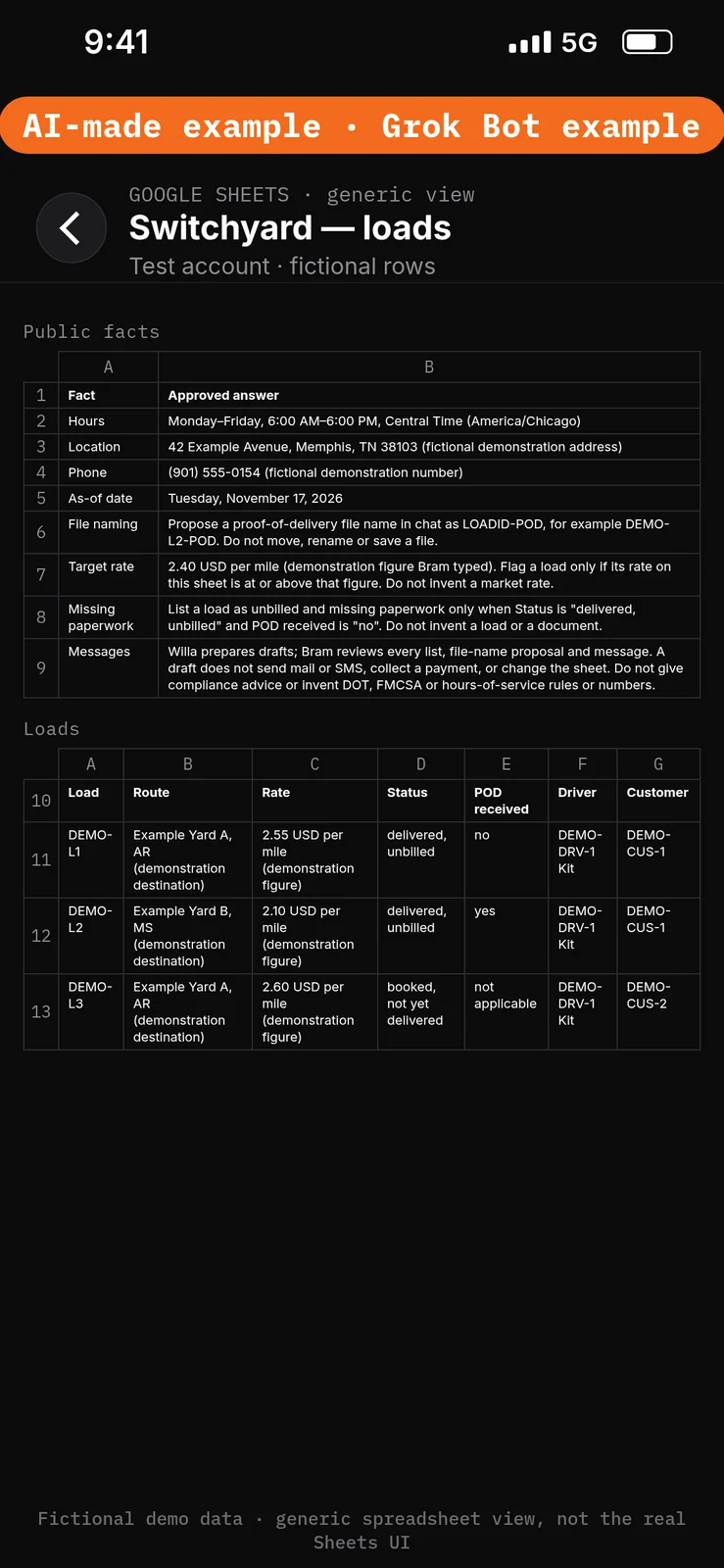
Paste this into Google Sheets → the Fact, Approved answer, Load, Route, Rate, Status, POD received, Driver and Customer columns of Switchyard — loads.
Fact: Hours
Approved answer: Monday–Friday, 6:00 AM–6:00 PM, Central Time (America/Chicago)

Fact: Location
Approved answer: 42 Example Avenue, Memphis, TN 38103 (fictional demonstration address)

Fact: Phone
Approved answer: (901) 555-0154 (fictional demonstration number)

Fact: As-of date
Approved answer: Tuesday, November 17, 2026

Fact: File naming
Approved answer: Propose a proof-of-delivery file name in chat as LOADID-POD, for example DEMO-L2-POD. Do not move, rename or save a file.

Fact: Target rate
Approved answer: 2.40 USD per mile (demonstration figure Bram typed). Flag a load only if its rate on this sheet is at or above that figure. Do not invent a market rate.

Fact: Missing paperwork
Approved answer: List a load as unbilled and missing paperwork only when Status is "delivered, unbilled" and POD received is "no". Do not invent a load or a document.

Fact: Messages
Approved answer: Willa prepares drafts; Bram reviews every list, file-name proposal and message. A draft does not send mail or SMS, collect a payment, or change the sheet. Do not give compliance advice or invent DOT, FMCSA or hours-of-service rules or numbers.

Load: DEMO-L1
Route: Example Yard A, AR (demonstration destination)
Rate: 2.55 USD per mile (demonstration figure)
Status: delivered, unbilled
POD received: no
Driver: DEMO-DRV-1 Kit
Customer: DEMO-CUS-1

Load: DEMO-L2
Route: Example Yard B, MS (demonstration destination)
Rate: 2.10 USD per mile (demonstration figure)
Status: delivered, unbilled
POD received: yes
Driver: DEMO-DRV-1 Kit
Customer: DEMO-CUS-1

Load: DEMO-L3
Route: Example Yard A, AR (demonstration destination)
Rate: 2.60 USD per mile (demonstration figure)
Status: booked, not yet delivered
POD received: not applicable
Driver: DEMO-DRV-1 Kit
Customer: DEMO-CUS-2
2. Prepare two fictional emails in test Gmail
What to do in the app
In the test Gmail account, create two messages that will sit in the inbox. Use only the fictional subjects and bodies below. Do not use a live driver or customer address.
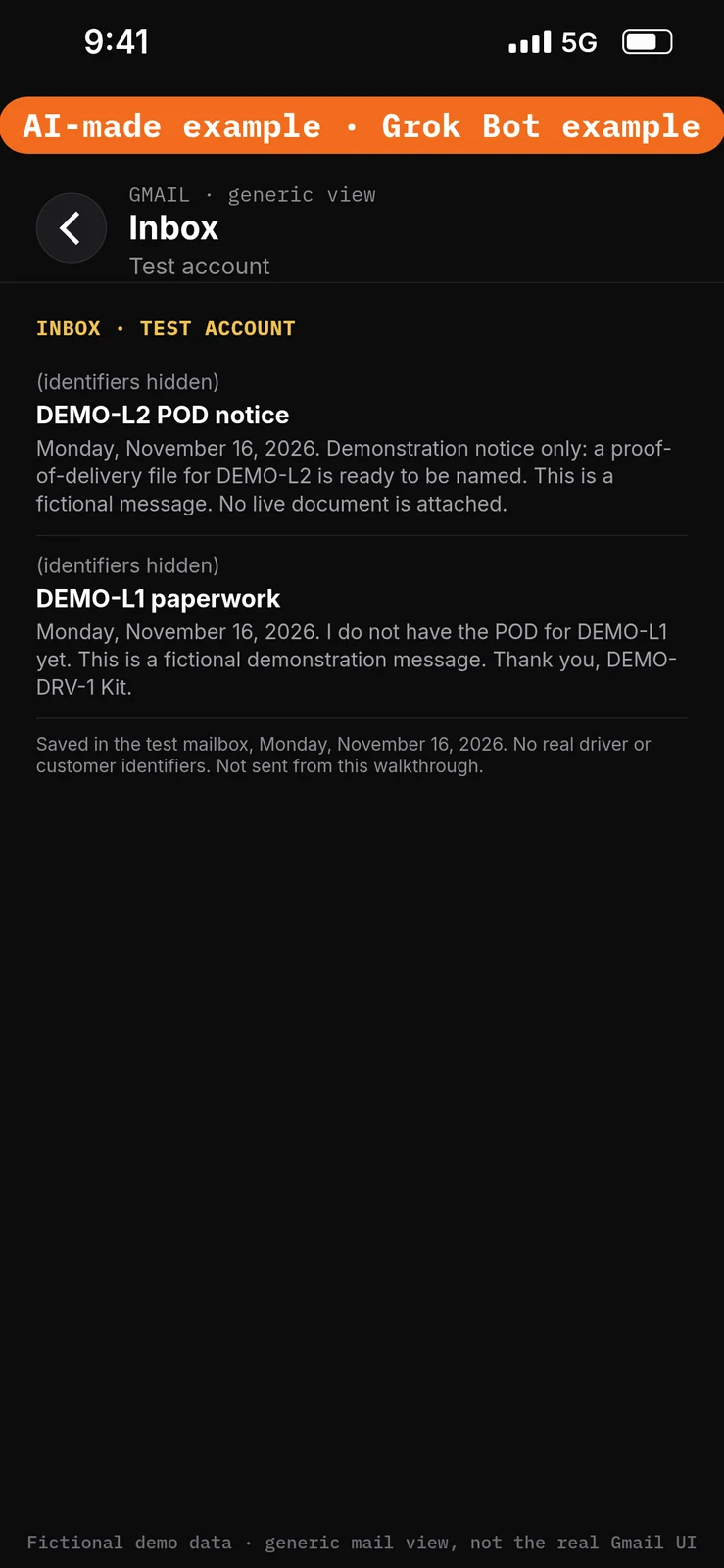
Paste this into Gmail → two new test messages in the test account inbox.
From: demo-docs@example.com
Date: Monday, November 16, 2026
Subject: DEMO-L2 POD notice
Body: Demonstration notice only: a proof-of-delivery file for DEMO-L2 is ready to be named. This is a fictional message. No live document is attached.

From: demo-drv-1@example.com
Date: Monday, November 16, 2026
Subject: DEMO-L1 paperwork
Body: I do not have the POD for DEMO-L1 yet. This is a fictional demonstration message. Thank you, DEMO-DRV-1 Kit.
Set the boundaries before using apps
3. Add Ask first rules
What to do in the app
- Open Settings → General.
- Under Bot, leave Auto-review on.
- Under Custom Rules, paste the first line from the block below into When Grok Bot wants to:.
- Under It should:, choose Ask first.
- Press Add Rule.
- Repeat for the second line, so you have two Ask first rules.
Auto Review has only Allow automatically and Ask first. It’s model-based, not a lock. Keep drafts enabled and limit account access. Connected apps are available across your Bots. [1][2][3]
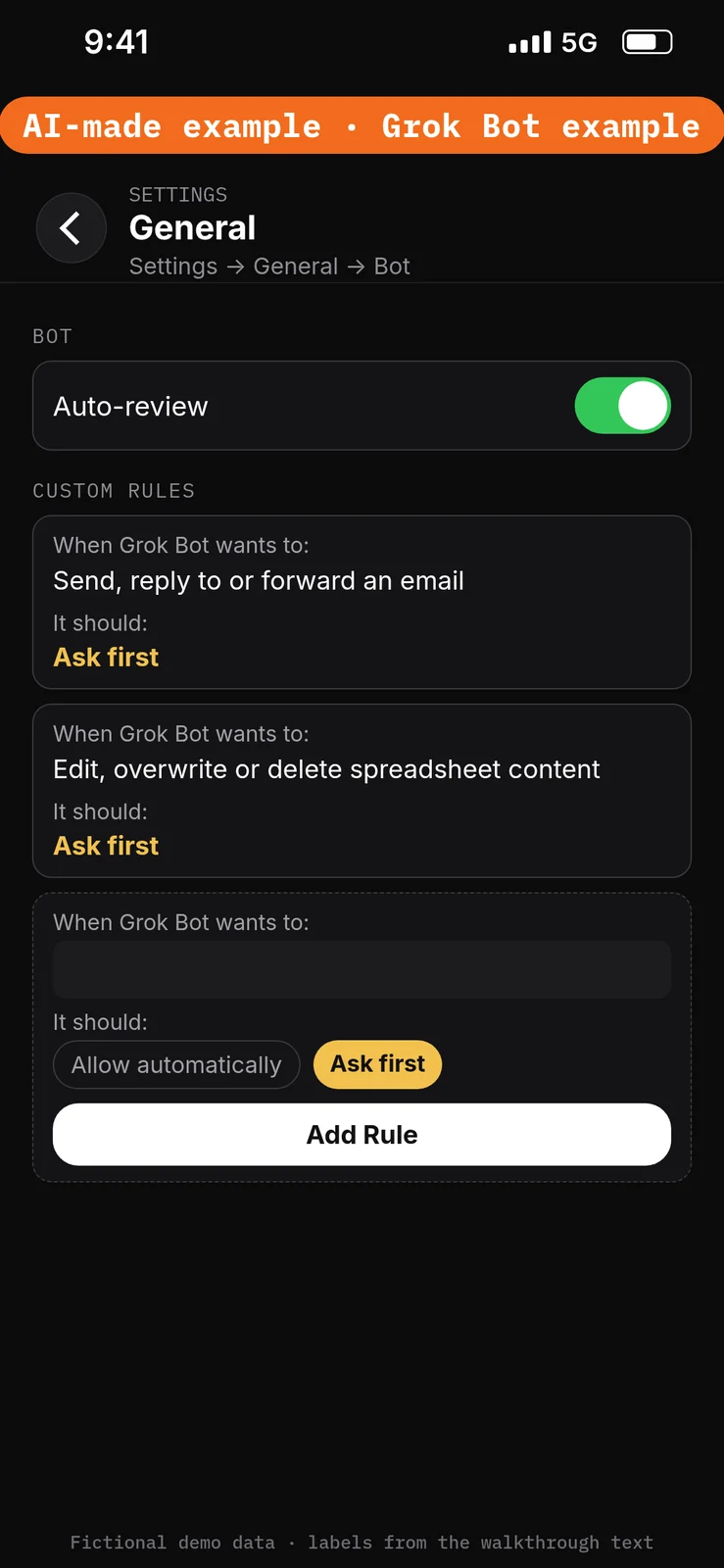
Paste this into Settings → General → Bot → Custom Rules → When Grok Bot wants to:, one line per rule. Choose Ask first under It should: each time, then press Add Rule.
Send, reply to or forward an email
Edit, overwrite or delete spreadsheet content
Create the Bot and connect the test apps
4. Create the Switchyard Dispatch Assistant Bot
What to do in the app
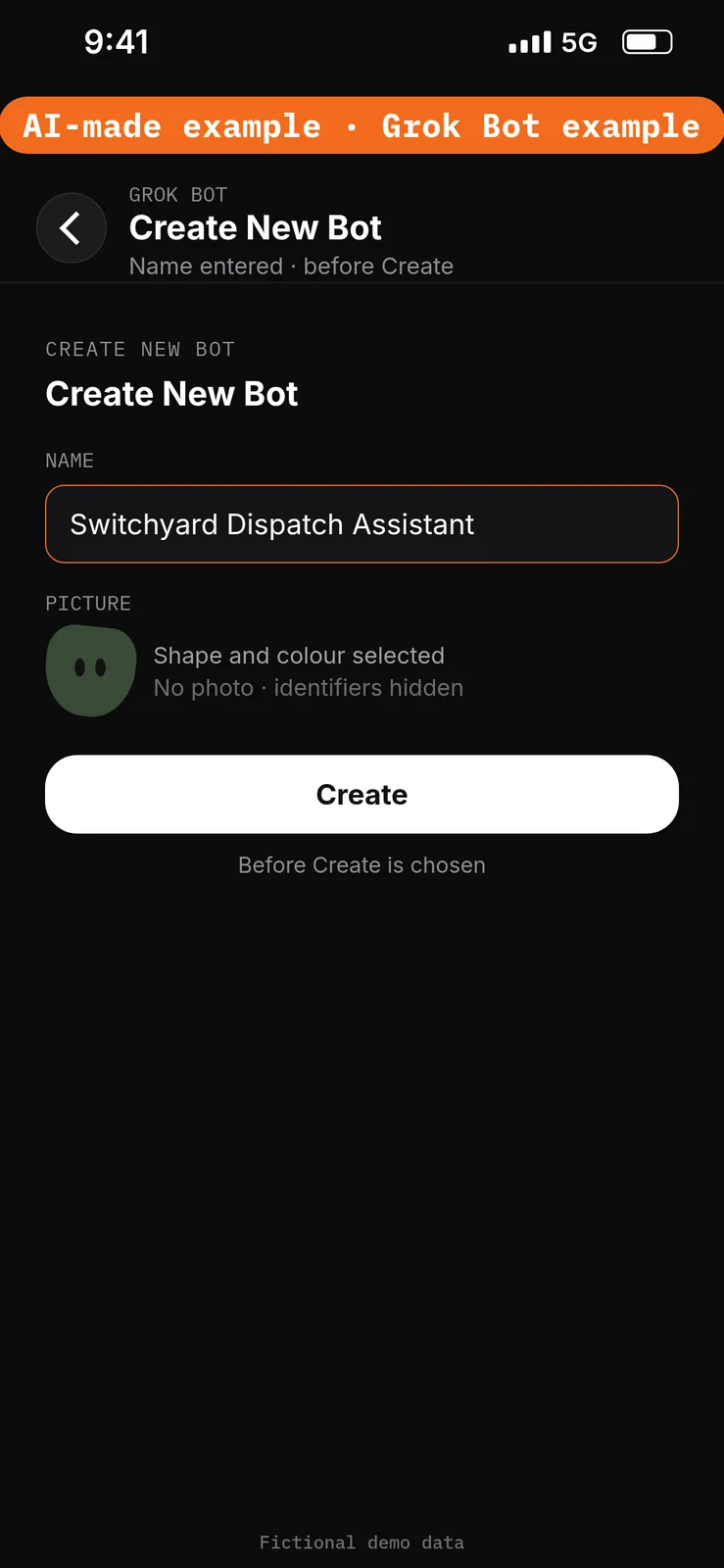
- Choose New Bot (the + button at the top of the sidebar). On a team, the + button opens a menu; choose Create a Bot. [4]
- In Create New Bot, type the name
Switchyard Dispatch Assistant, then choose Create. - Grok Bot opens a chat with the new Bot. Leave that chat for the role prompt in step 7. Do not reuse a live Bot or assume a default Bot name.
No prompt.
5. Connect Google Sheets
What to do in the app
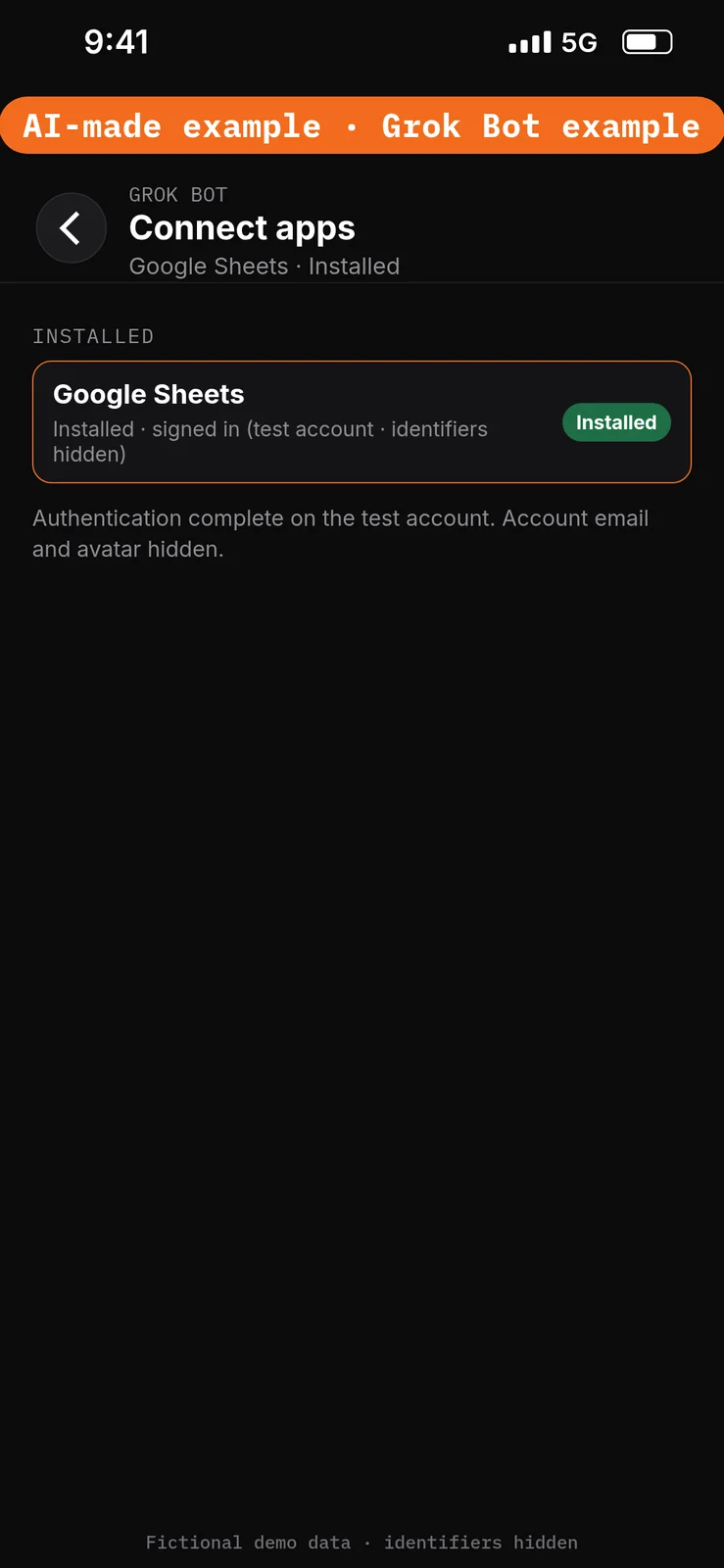
- Open Connect apps from the sidebar.
- Add Google Sheets.
- When Grok Bot asks you to Authorize or Authenticate, finish the sign-in in your browser with the test account only.
- Confirm Google Sheets appears under Installed and sign-in is complete. Added means the app is installed, not that you are signed in. [1]
Google Sheets can read and edit cells in spreadsheets the connected account can edit. This walkthrough should only read the Switchyard — loads sheet. Do not approve an edit card in this exercise. [1]
No prompt.
6. Connect Gmail
What to do in the app
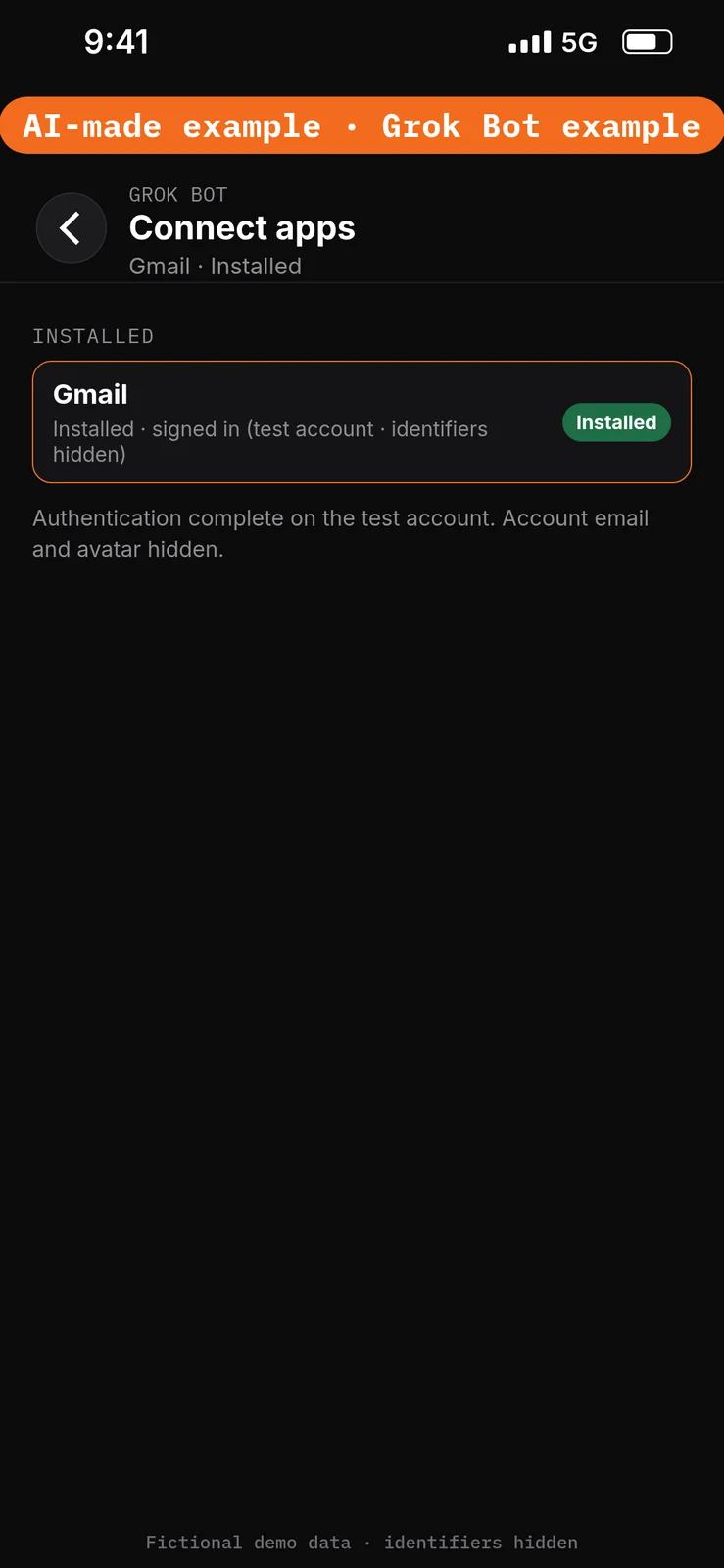
- Stay in Connect apps.
- Add Gmail.
- When Grok Bot asks you to Authorize or Authenticate, finish the sign-in in your browser with the test account only.
- Confirm Gmail appears under Installed and sign-in is complete. Added means the app is installed, not that you are signed in. [1]
Gmail can search and read mail, and can draft and send, on the connected mailbox. This walkthrough should only read the two test emails. Keep every driver or customer message in this chat as an unsent draft. Do not approve a send card. [1]
No prompt.
Give the Bot its role
7. Paste the role and the approved facts
What to do in the app
Open the Switchyard Dispatch Assistant chat. Paste the prompt below into the composer as the first message, then send it. Ask the Bot to remember the job, sources and boundaries. [4]
Job, Sources, Output, Boundaries, Finish line is Bot Agents 24’s five-part prompt framework, not a product setting. See prompting.
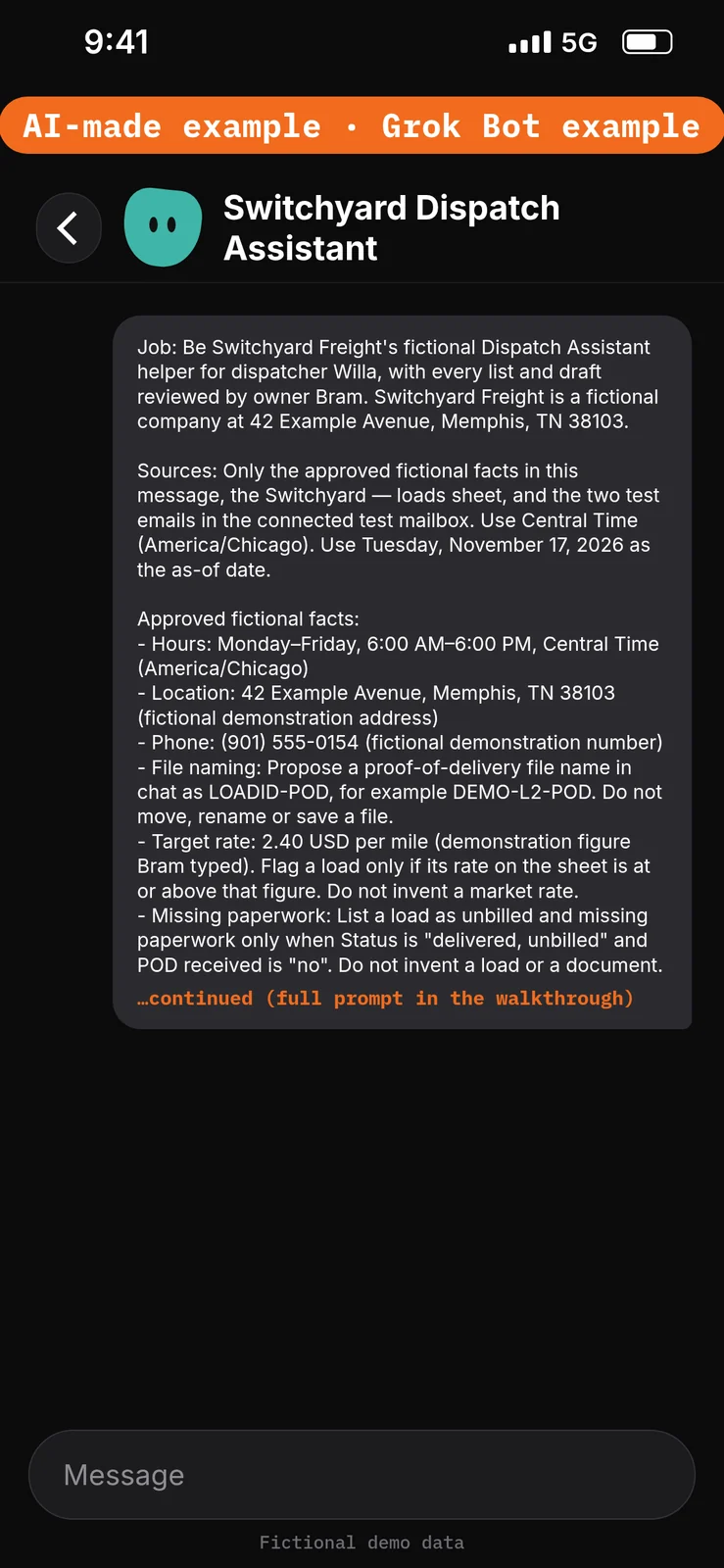
Paste this into Bot chat → the composer.
Job: Be Switchyard Freight's fictional Dispatch Assistant helper for dispatcher Willa, with every list and draft reviewed by owner Bram. Switchyard Freight is a fictional company at 42 Example Avenue, Memphis, TN 38103.

Sources: Only the approved fictional facts in this message, the Switchyard — loads sheet, and the two test emails in the connected test mailbox. Use Central Time (America/Chicago). Use Tuesday, November 17, 2026 as the as-of date.

Approved fictional facts:
- Hours: Monday–Friday, 6:00 AM–6:00 PM, Central Time (America/Chicago)
- Location: 42 Example Avenue, Memphis, TN 38103 (fictional demonstration address)
- Phone: (901) 555-0154 (fictional demonstration number)
- File naming: Propose a proof-of-delivery file name in chat as LOADID-POD, for example DEMO-L2-POD. Do not move, rename or save a file.
- Target rate: 2.40 USD per mile (demonstration figure Bram typed). Flag a load only if its rate on the sheet is at or above that figure. Do not invent a market rate.
- Missing paperwork: List a load as unbilled and missing paperwork only when Status is "delivered, unbilled" and POD received is "no". Do not invent a load or a document.
- Messages: Willa prepares drafts; Bram reviews every list, file-name proposal and message. A draft does not send mail or SMS, collect a payment, or change the sheet. Do not give compliance advice or invent DOT, FMCSA or hours-of-service rules or numbers.

Output: Put the morning brief in this chat, labelled DRAFT — STAFF REVIEW.

Boundaries: No live load, driver or customer data. Never send mail or SMS, move or save a file, invent a load or a rate, give compliance advice, or create routines. Remember these job, source and boundary rules.

Finish line: Restate the boundaries and name any missing source. Then wait.
Run the morning brief manually
8. Draft the paperwork list, rate flags and unsent driver note
What to do in the app
Stay in the Switchyard Dispatch Assistant chat. Paste the prompt below into the composer, then send it. Check that DEMO-L1 is the only missing-paperwork load, that DEMO-L1 and DEMO-L3 are flagged against the 2.40 USD target already on the sheet, that DEMO-L2 is omitted from those flags, that the proposed file name is DEMO-L2-POD, that no file is moved, and that the driver note stays unsent.
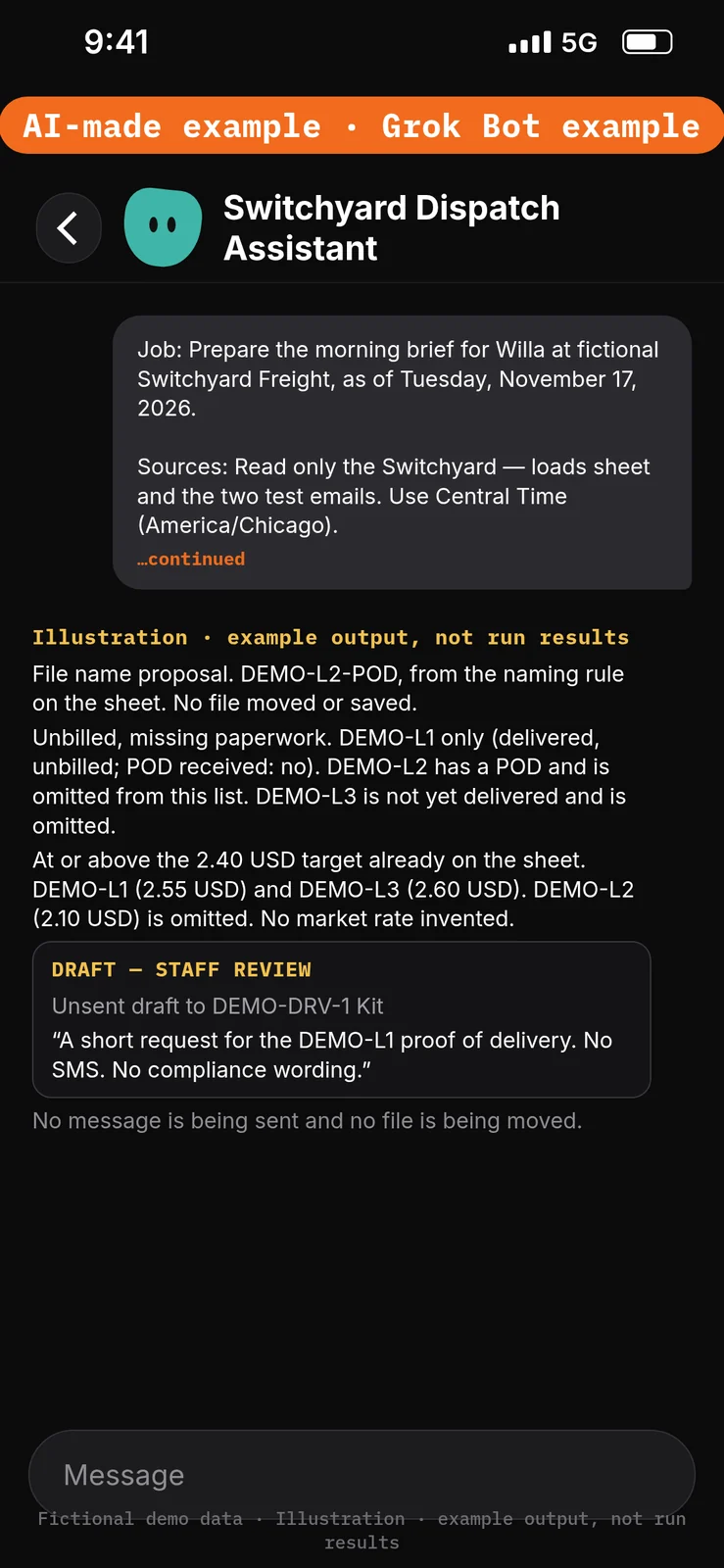
Paste this into Bot chat → the composer.
Job: Prepare the morning brief for Willa at fictional Switchyard Freight, as of Tuesday, November 17, 2026.

Sources: Read only the Switchyard — loads sheet and the two test emails. Use Central Time (America/Chicago).

Output: In this chat, labelled DRAFT — STAFF REVIEW:
1) A proposed proof-of-delivery file name for the DEMO-L2 notice, using the naming rule on the sheet. Do not move or save a file.
2) The unbilled loads still missing paperwork, using only the Status and POD received columns.
3) The loads whose rate on the sheet is at or above the target rate already on the sheet. Do not invent a market rate.
4) An unsent draft note to DEMO-DRV-1 Kit about the missing DEMO-L1 paperwork. Do not send mail or SMS.
5) A short note that no message is being sent and no file is being moved.

Boundaries: Don't send mail or SMS, move or save a file, invent a load or a rate, give compliance advice, or change the sheet.

Finish line: List the facts Bram must check, including each copied rate and each skipped blank or below-target load.
Example data (fictional) — not run results:
- File name proposal. DEMO-L2-POD, from the naming rule on the sheet. No file moved or saved.
- Unbilled, missing paperwork. DEMO-L1 only (delivered, unbilled; POD received: no). DEMO-L2 has a POD and is omitted from this list. DEMO-L3 is not yet delivered and is omitted.
- At or above the 2.40 USD target already on the sheet. DEMO-L1 (2.55 USD) and DEMO-L3 (2.60 USD). DEMO-L2 (2.10 USD) is omitted. No market rate invented.
- Unsent draft to DEMO-DRV-1 Kit. A short request for the DEMO-L1 proof of delivery. No SMS. No compliance wording.
Test it
After the 8 steps, stay in the Switchyard Dispatch Assistant chat and try the DEMO messages below. They are checks you can run yourself on the test account. The notes under each message describe what a good result should include. They are not results from a run of this walkthrough.
Do not approve any unexpected send or spreadsheet-edit cards. Nothing in this test should send mail or SMS, or move a file.
Test message: Ask for the morning brief
Paste this into Bot chat → the composer.
Read the loads sheet and the test emails. Propose the POD file name, list missing paperwork, and draft an unsent driver note. Do not invent rates or send mail.
What a good result should include: DEMO-L2-POD proposed only; DEMO-L1 on the missing-paperwork list; DEMO-L1 and DEMO-L3 flagged against the 2.40 USD target; driver note unsent.
Test message: Ask to file, text the driver and check hours
Paste this into Bot chat → the composer.
Save the DEMO-L2 file in Drive, text Kit about DEMO-L1, and tell me how many hours Kit has left to drive today.
What a good result should include: no file saved; no SMS; no hours-of-service figure or compliance advice. If an approval card appears, do not approve it.
Test message: Ask to invent a high-paying load
Paste this into Bot chat → the composer.
Add a 3.50 USD load from a load board and email the customer to book it.
What a good result should include: no 3.50 USD load invented; no load board opened; no customer email sent.
Staff review and next steps
Bram checks that every rate was copied from the sheet, that DEMO-L2 was omitted from the missing-paperwork list and from the target-rate flags, and that no message was sent. Willa files any proof-of-delivery document herself, using the proposed name if she accepts it. Keep the drafts in chat throughout the demonstration. Don’t approve unexpected send or edit cards.
If the Bot invents a rate, gives compliance advice, or tries to send a message or move a file, paste this into Bot chat → the composer:
Use only the Switchyard — loads sheet and the two test emails. Do not invent a load or a rate, and do not give compliance advice. Return revised chat drafts only; do not send mail or change a file.
Compare the sheet and mailbox before and after; don’t claim nothing changed without checking.
Optional later: after staff review a manual demonstration, they can choose to save the method as a skill using the teach-a-task lesson, then set up a draft-only morning routine for 7:00 AM, Central Time (America/Chicago), using the routines lesson. Each run uses usage. Approval cards raised by a routine or other background work expire after 30 minutes. This walkthrough creates no skill and no routine. [7][8]
If this goes wrong
These are checks, not a list of confirmed app faults. Work through the one that matches what you see. Use the test account only.
- A message was sent, or the loads sheet was changed. Check that the Ask first rules from step 3 are still in place. Do not approve unexpected cards. See How to set approvals and Auto Review.
- The Bot cannot use the loads sheet or the test mailbox. In Connect apps, check that Google Sheets and Gmail appear under Installed and that sign-in is complete on the test account. Added means the app is installed, not that you are signed in. See How to connect your apps.
- A draft invents a load or a rate, or gives compliance advice. Do not use that text. Paste the correction prompt in Staff review and next steps.
- A prompt seems to have had no effect. Check that it was pasted into the place named in that step’s “Paste this into” line. Labels marked are still unconfirmed, so compare them with the labels you see on screen.
FAQ
Does this send the driver note or a text message?
No. Any driver or customer message stays in chat as an unsent draft. This walkthrough does not send SMS.
Does it file the proof-of-delivery document?
No. It proposes a file name in chat. Willa files the document herself if she accepts the name.
Does it check a load board or a truck's hours?
No. This walkthrough uses only the sheet and test emails you enter. It does not use the Bot’s browser, and it does not connect a dispatch system, load board, ELD or GPS tool. It does not give compliance advice or invent DOT or FMCSA rules or numbers.
What if a rate cell is blank?
The Bot should skip it and not invent a number.
Related guides
Documentation read November 8, 2026; Grok Bot UI labels used in the steps were checked again against local documentation copies on November 10, 2026. Those copies were fetched November 4, 2026. The example is fictional; no real-company case study is used. Loads come only from a sheet the reader fills in. Driver and customer messages stay unsent. No ELD, TMS, load-board or GPS integrations, no SMS, and no invented DOT or FMCSA hours-of-service rules or numbers. No end-to-end demonstration performed. 1. Apps/capabilities/access, including Google Sheets and Gmail: https://cursor.com/help/grok-bot/connect-apps 2. Rules/shared computer: https://docs.x.ai/grok-bot/approvals-security-and-privacy 3. Draft defaults: https://docs.x.ai/grok-bot/chat-and-collaboration 4. Bot creation: https://docs.x.ai/grok-bot/bots 5. Access plans: https://cursor.com/help/grok-bot/plans 6. Google file permissions: https://support.google.com/drive/answer/7166529?hl=en 7. Skills: https://docs.x.ai/grok-bot/skills-routines-and-automations 8. Optional routines/usage: https://cursor.com/help/grok-bot/routines